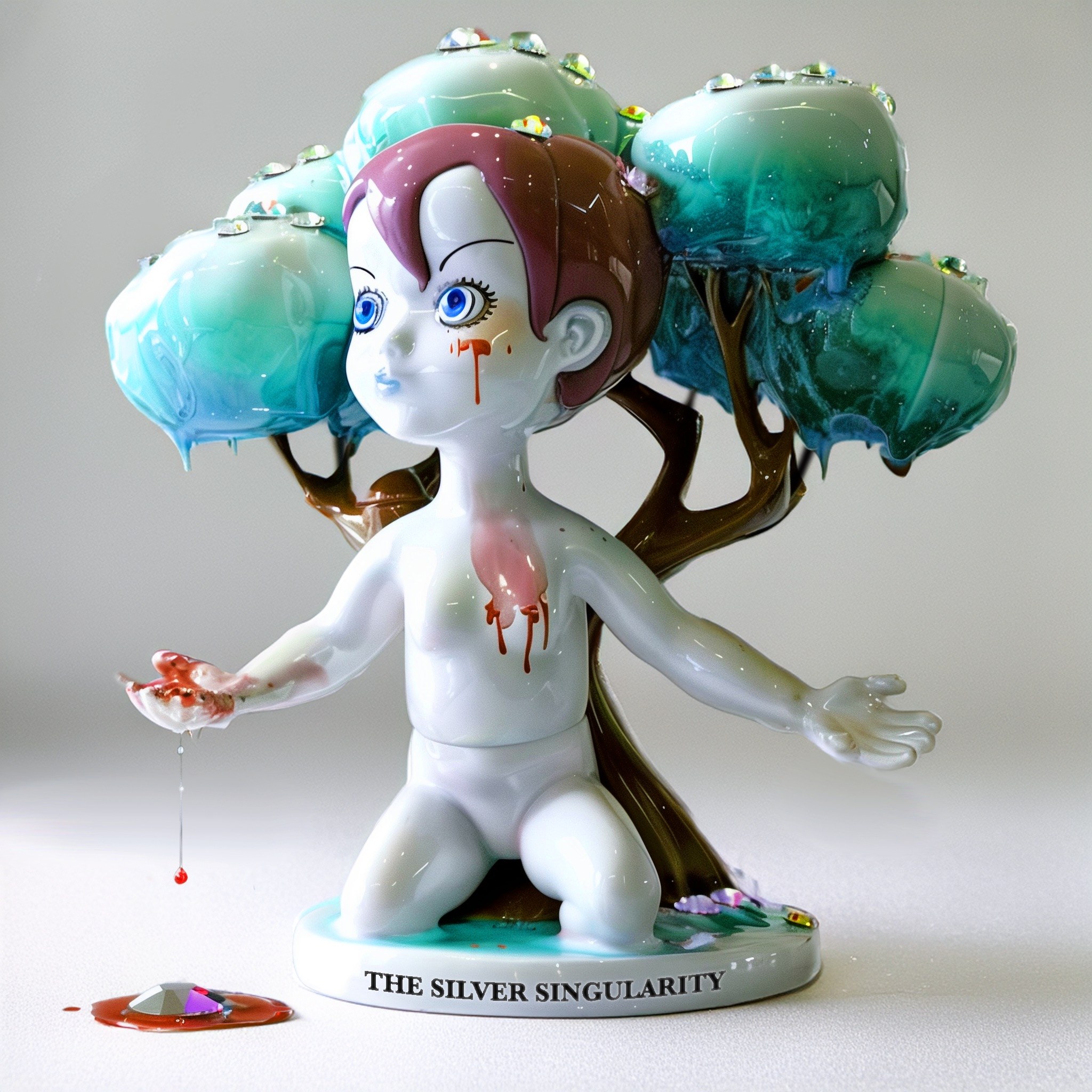
Context
Genoa, 2001-07-20, 17:27h
The historical fact the work pivots on, and the speculative system built from it. Background, left. Theory, right.
Background
The fork is set during the anti-globalization protests in Genoa in July 2001, the high point of a global anti-globalization movement also remembered for the human-rights abuses inflicted on demonstrators. At 17:27h on 20 July, activist Carlo Giuliani was shot dead at the G8 protests. UBERMORGEN treats this single second as the only fixed point in an otherwise unstable universe: the singularity every parallel reality rotates around.
'Everything has happened, and nothing has happened... The one absolute, irreversible event is the death of Carlo Giuliani. This singularity is the axis every parallel reality spins on.'
Piracy, twice over
UBERMORGEN has long studied piracy as a collaborative, technological form of resistance. In 2010, the team produced 'Woppow: Somali Pirate Fashion,' recasting Somali pirates as folk heroes, against the dominant narrative of global capital. The Silver Singularity continues that thread: North Korea's state-backed 'Lazarus Group' crypto-piracy, Houthi rebels hijacking ships in the Red Sea, and other real, historical, or fictional forms of state-sponsored piracy are folded in here, alongside a resurrected anti-globalization idealism, hijacking method and geography to imagine new distributions of resources.
Happy Dystopia → Radical Universalism
The Silver Singularity (2024) is the closing chapter of UBERMORGEN's 'Happy Dystopia' cycle (2020–2024) and the launch platform for the team's next cycle, 'Radical Universalism' (2025–2030). Both are set against what UBERMORGEN calls our present 'Neo-Biedermeier age,' an aesthetic of comfort and retreat that collides, painfully, with the hijacked late-capitalist, historical sci-fi material in this work. As the artists put it: the past lies clearly before us, the future hides behind us. Times change, places remain.
Theory
No linearity. No priorities. No decisions.
The Silver Singularity proposes a universe without sequence: all events both existing and non-existent, converging into a single chaotic reality, anchored to one irrefutable point: the shooting of Carlo Giuliani.
In the realm of UBERMORGEN, there is no linearity, no simultaneous occurrences, no rankings, and no priorities. Timelines aren't separate time axes like in Back to the Future. There are no decisions to be made. Everything has happened, and nothing has happened.
Alternative realities and alternate timelines blur into a seamless web where every potential outcome and its negation coexist in a state of perpetual flux. The past, present, and future collapse into a singular point, rendering traditional concepts of time and causality obsolete. Each alternate reality is an alternate timeline, branching from the singularity of Carlo's shooting, yet forever tethered to it. The website itself becomes a living entity, producing and evolving over time, mirroring the fluid and ever-changing nature of these alternate realities.
On Forking as a Form of Care
An essay by Rao Jia-Yin, independent theorist, formerly of an unlicensed reading room in Yanji
Somewhere east of every collapsed century there is a basement that still smells of clay. I am told this one is in Choryang House, but it could be anywhere: basements are the one architecture that refuses to modernize. The Silver Singularity begins from a single, unbearable second: 17:27h, Genoa, 20 July 2001, the instant a young man named Carlo Giuliani stopped being a person and became a coordinate. UBERMORGEN does not mourn this second. They mine it. They fire it into ceramic and run silver through the firing cracks until the object conducts. This is the first theoretical move worth naming: grief, treated correctly, is a semiconductor.
We live, the artists insist, in a Neo-Biedermeier age, a century turned inward, decorating its rooms while the weather outside gets stranger. I recognize this mood from my own training as much as theirs. My grandmother kept her opinions in a drawer and her embroidery on the wall, and called this dignity; she was not wrong, only early. What the Society of twelve proposes (a mixologist in Busan, an astronaut on the ISS, a waste-collector in Dubai, a non-binary scholar hiding in Borneo's canopy) is that the drawer and the wall can be the same furniture. You decorate the room and you run the network through the teapot. Comfort is not the opposite of resistance; it is, increasingly, its only remaining disguise.
Piracy recurs across this work: Somali coastlines in 2010, Lazarus Group's crypto heists, Houthi interceptions in the Red Sea, now braided with the 2001 anti-globalization wave that Genoa tried, and failed, to extinguish with a single bullet. I want to resist reading this as nostalgia for a more romantic outlaw age. It is closer to an argument about authorship: that no timeline owns its own outcome, that every 'original' event is already a fork someone else is living differently, somewhere else, right now. The website you are reading is not documentation of the installation. It is another branch of it: alive, mutable, capable of being wrong in ways the porcelain in Busan cannot.
This is, I think, the quiet center of UBERMORGEN's closing chapter of Happy Dystopia: that a fixed point is not a prison. Carlo's second does not trap the twelve members of the Society: it frees them into difference. Radical universalism, the cycle this work hands off to, will need exactly this kind of freedom: not one future for everyone, but everyone's future, forking, conducted in silver, kept warm in moss. I no longer believe the past is evident and the future invisible, as the artists like to say. I think we have it backwards, and that is the more interesting error to sit with.
Press coverage
-
Phileas · November 2024
UBERMORGEN, by Anna Hugo
The fullest written account of the work to date: the genesis of the curatorial invitation, the Carlo Giuliani / 'Genoa 2001' premise, the forest-and-silver-ceramic installation, the website's spy-thriller fiction layer, and UBERMORGEN's history.
-
Busan Biennale 2024 · Official exhibition listing
Artist page, Busan Biennale 2024
17 August – 20 October 2024, Choryang House.
-
Austrian Embassy Seoul (BMEIA)
Official event notice
Official notice from the Austrian federal government.
-
Artnet News · 19 October 2024
The 2024 Busan Biennale Is Eccentric, Vexing, and Full of Thrills
By Andrew Russeth. General biennale review; covers the 'piratical enlightenment' (after David Graeber) curatorial theme this piece's piracy framing speaks to.
-
ArtReview Asia · 1 November 2024
Busan Biennale 2024 Review: Artistic Privilege Is Swept Aside
By Mark Rappolt. Review of the biennale's 'Seeing in the Dark' theme, its curatorial solidarity, and piratical-enlightenment framing.
-
e-flux Criticism
Busan Biennale 2024: Seeing in the Dark
By Harry Burke. General review of the biennale.
-
Reference biography
UBERMORGEN: founded 1995 in Vienna by lizvlx and Luzius Bernhard. For The Silver Singularity and the current cycle, the team works two-generational, multidiverse, and female-led (lizvlx, Luzius Bernhard, Billie Bernhard, and Lola Bernhard), in the Net.Art lineage, with Vote Auction (2000) among its best-known works. Full bio and Wikipedia entry on the UBERMORGEN page.
-
38C3 · Chaos Communication Congress, December 2024
Klarheit als Waffe, talk
The team's recent public talk. See also the speaker page.
For press materials, contact press@phileas.art.